 Skip to content

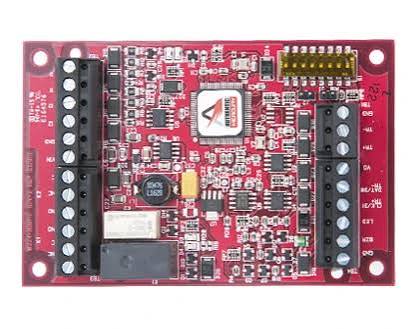
Most current Mercury controllers can scale to 64 doors (readers/openings) using downstream expansion modules, while the single-door 1501 models stop at 17. The MP1501 expands to 17 readers/openings, and the MP1502 and MP4502 expand to 64. Your real limit may be lower, because the host access control software can impose its own ceiling.
What counts as an “entry point”?
In this guide we will explain How Many Entry Points Can Mercury Controllers Support, an entry point is one controlled opening: a door, gate or barrier with a reader and the inputs and outputs that monitor and release it. A controller’s onboard capacity is small. The rest comes from expansion modules on its RS-485 bus.
Capacity by Mercury model
| Model | Native readers / openings | Maximum with expansion | Cardholders |
|---|---|---|---|
| MP1501 | 2 readers / 1 opening | 17 | 240,000 |
| MP1502 | 4 readers / 2 openings | 64 | 240,000 |
| MP2500 | None onboard | 64 (via expansion) | 600,000 |
| MP4502 | 4 readers / 2 openings | 64 | 2,000,000 |
A licensed MP1502-GT variant supports 4 single-reader doors using onboard I/O only, which is useful for small sites. [VERIFY firmware and licensing details.]
Why published door counts disagree
The controller sets the hardware ceiling. The software sets the number you can actually use. Brivo, for example, supports 30 doors on the 1502/4502 panels, 28 on the 2500 and 17 on the 1501, even though the hardware can go further. Real capacity depends on five things:
- The controller model.
- The expansion hardware you add (door interface modules and I/O boards).
- The host or OEM software and its licensing.
- Cardholder and event-buffer limits.
- Network design and power.
Always confirm the software’s limit before specifying hardware.
How to scale a Mercury system
Add downstream modules to the controller’s RS-485 bus until you reach the model’s maximum. The MP1502 supports up to 32 additional expansion modules. Beyond that, or for separate buildings, add more controllers rather than pushing one panel to its limit. Plan cable runs, power and spare capacity before choosing a model, and leave headroom for future doors.
Are Mercury controllers suitable for high-security environments?
They can be, as part of a properly designed system. The controller provides strong building blocks; site design, software and policy do the rest. Documented features include:
- Encrypted reader communication: OSDP Secure Channel for reader connectivity.
- Encrypted host and expansion links: TLS-protected host communications and AES-protected controller-to-expansion connections.
- Network access control: 802.1X port-based authentication.
- Hardware protection: a crypto memory chip across the range, plus secure boot, ARM TrustZone and data encryption at rest on the MP controllers.
- Cryptography: the MP series cites TLS 1.3 and FIPS 140-3 use of OpenSSL. This means the controller uses OpenSSL with FIPS-validated modules, not that the whole controller is a FIPS-validated device. [VERIFY wording against HID.]
- Independent operation: the LP1502 can perform access control functions independently of the host.
- Compliance: UL294 recognised, CE compliant and NIST-certified encryption on the LP series. [VERIFY UK/EU equivalents, e.g. BS EN 60839 relevance.]
- Government-grade options: support for FICAM strong authentication for FIPS-201 environments.
What the controller does not do: it can’t fix weak readers, unencrypted wiring, poor network segmentation, weak credentials or lax admin practices. A secure Mercury deployment needs OSDP Secure Channel readers, a hardened network, firmware kept current and a host platform configured to match.
When another approach may fit
If you need cloud-native management without OEM software, or the site is a handful of doors with no growth, a simpler system may cost less. The right choice depends on host software, door count and security requirements.
How XS Controls helps
As an HID reseller, XS Controls can help you select and size Mercury hardware, check compatibility with your host software, and supply the right expansion modules. [Add confirmed services: lead times, technical support, integration help.]
FAQs
How many doors can one Mercury controller control directly? Onboard, between one and two openings, depending on model.
Can Mercury controllers run without the host? They make access decisions locally; check your software for offline behaviour.
Do I need new controllers if I outgrow one? Usually you add expansion modules first, then controllers.
Is the EP series still sold? One partner notes the EP series is end-of-life and replaced by the LP series, and the MP series is the current line. [VERIFY.]
Does Mercury support OSDP? Yes, including Secure Channel on supported ports.
